
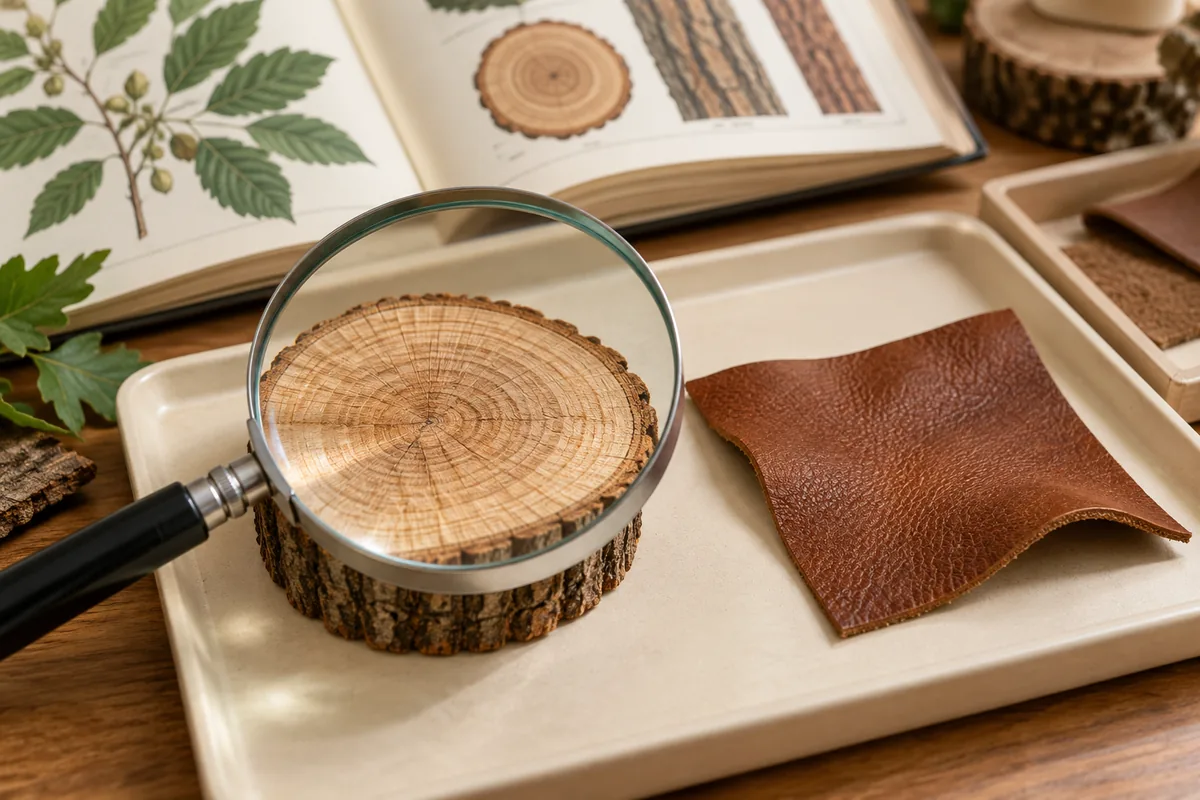
The species of a finished product is not always evident from its surface pattern. Colouring, tanning, coatings and mechanical processing can alter the diagnostic features of wood, leather and other natural materials. The commercial name and visual similarity are therefore treated as source information, not the final answer.
Identify the object itself first
Record the entire product, its dimensions, labelling, components and acquisition or provenance documents. Different parts of a composite object may be made from different materials. A conclusion about one element must not be extended to the whole item without justification.
Which documents are useful
- The product description and information on the stated material.
- Delivery and provenance documents relating to the particular item.
- Information on processing, restoration, repairs and applied coatings.
- Photographs of the overall item, joints and accessible surfaces.
- A list of parts whose species identification is actually disputed.
Why a photograph may be insufficient
An image allows discussion of the preliminary task and availability of features. But a photograph does not always convey surface structure, internal structure or features discernible only under magnification or by another examination. Missing features must not be filled in on the basis of the trade description.
For example, a coloured wood surface may conceal its structure, while embossing may imitate a natural pattern. The presence of an imitation also requires examination: an unusual appearance does not automatically establish that a product is artificial.
Do not take a sample yourself
Before drilling, cutting or separating a fragment, agree on the necessity, location and permissibility of the intervention. Destructive examination requires justification and appropriate permission from the owner or the body that appointed the examination. Unauthorized sampling may damage a valuable item and sever the link between the sample and a particular component.
Species and the legal regime are different levels
Determining the nature of a material does not replace checking the legality of the product's circulation. Protected-species lists, documents, provenance and circumstances of movement may matter to the legal assessment. Their applicability is checked for the particular case and period; a commercial name is not the same as a scientific species name.
The final document should make clear the taxonomic level supported by the answer and the features examined. If processing prevents identification of the exact species, a proper conclusion must retain that limitation rather than substitute a more familiar common name.